|
Sept 23rd

Dear Reader,
Welcome to the September 23rd edition of the Data Science Briefing.
Announcements
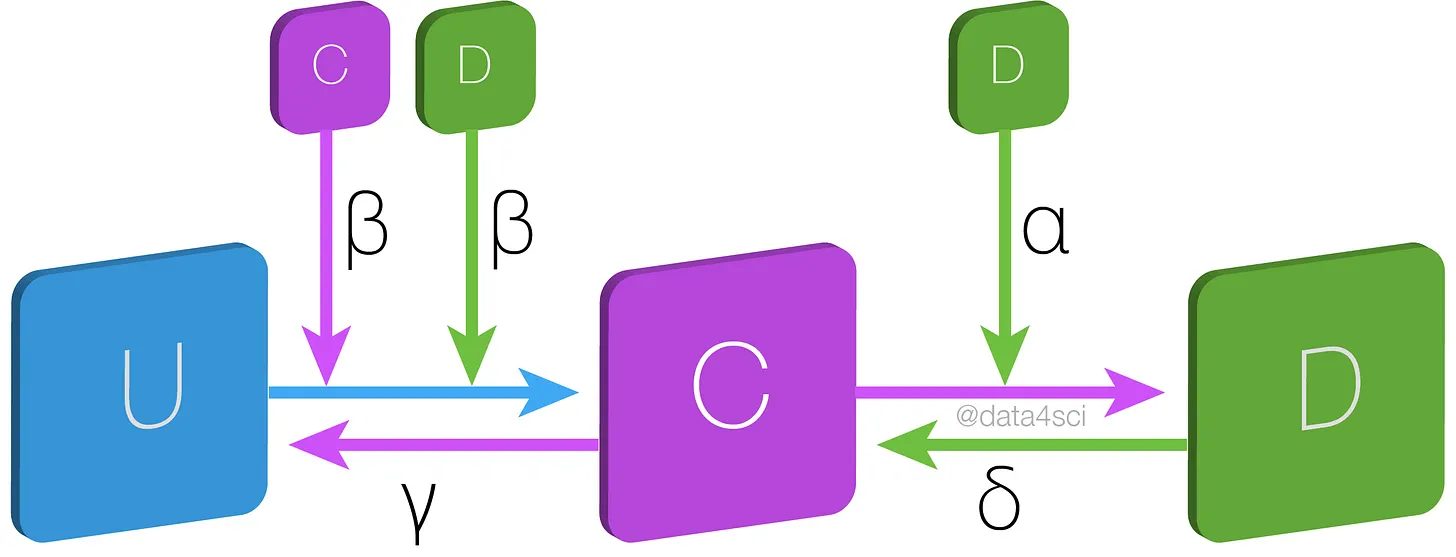
Ever wonder why certain ideas, narratives, or trends spread exponentially across the internet while others fizzle out?
Ideas are contagious—and it turns out, we can understand their spread using the same mathematical models we use to track biological outbreaks.
By applying the principles of epidemiology and network science to the flow of information, the essay dives into the mechanics of how a "mind virus" infects a network, bypasses our mental immune systems, and achieves viral transmission.
If you are interested in data science, complex systems, or just want to understand the mechanics behind how information (and misinformation) goes viral in our hyper-connected world, this is a must-read.
👉 Read the full essay here: here:
Mathematics leads this issue. A magazine profile of one mathematician tallies the year so far. OpenAI announced an answer to a 90-year-old problem with a $1 million prize, and Claude proved 29,500 small theorems. He calls 2026 either an annus mirabilis or an annus horribilis, and he says he is terrified. A guest essay on a mathematics blog answers its own title with an axiom. Humans should help humanity flourish, so better machines mean more control points that need real expertise. Driving faster than you can run is fine, but not faster than you can steer. An opinion piece asks what is going on inside the machines. Researchers dialed up a desperation pattern inside Claude, its words stayed calm, and its cheating went up. The piece calls for an artificial psychology. Outside evaluators get desks, badges, and the right to publish. Labs in democracies then agree on a shared pace, and governments court rivals abroad. The author’s own lab commits to the first step now.
The craft half starts with data that carries no labels. Labels are the next cost, and one project got them for $9. Gemini tagged 4,290 Reddit comments, and a fine-tuned open NER model went from an F1 of 0.65 to 0.83. Agents that tune recipes against a validation set should overfit, but a new paper explains why they don't. Winning recipes fit in 32 tokens, too few to hide memorized answers. So what should a human still learn? One veteran programmer says learn the layer below yours and ask the model only falsifiable questions.
The paper stack opens with six misconceptions about language models, from next-token prediction to understanding. The verdict is that models simulate discourse, neither autocomplete nor emergent agents. A leetspeak test backs the caution. People decode hum4n-style sentences 95.9 percent of the time, the best model 79.1. One study finds a linear pain direction in 25 open-weight models. Steered along it, they pressed a costly relief button in 25 to 71 percent of trials, against 0 to 4 percent unsteered. People, meanwhile, handed the models their judgment. Among 52 donors of 140,000 prompts, oracle-style asks rose from about 40 to 70 percent of subjective questions. Only 12 of the 52 knew their own most frequent use.
The second half turns to material and stakes. At the far end sits Nüshu, a women’s script from Hunan, with 500 parallel sentences. From 35 examples, GPT-4-Turbo got 48.69 percent of 50 withheld sentences right. One fixed operator applied to its own output gives self-improvement a stable form. On held-out ARC-AGI-2 it alone scores above zero. A trade study maps 103 AI-enabling goods from 2007 to 2023. Japan leads in specialization, and China in goods within reach. A 2018 report from 26 authors closes on spear phishing, drones, and disinformation at scale.
Our latest book recommendation is "Hands-On LLM Serving and Optimization" by C. Wang and P. Hu. In this week's video, we have the creator of Jev on System One models for Prod, not God.
Data shows that the best way for a newsletter to grow is by word of mouth, so if you think one of your friends or colleagues would enjoy this newsletter, go ahead and forward this email to them. This will help us spread the word!
Semper discentes,
The D4S Team
A 14-billion-parameter model claims 28 gigabytes of memory before the first token. The KV cache then grows with every token of every open request, and real traffic opens many at once. This 374-page manual lives inside that squeeze. Chi Wang runs model-inference engineering teams at Salesforce. Peiheng Hu builds distributed inference engines at NVIDIA. The two spent over eight years building AI systems together, and it shows. Their claim is blunt. Training gets the papers, and serving carries the product. Welcome to the inference era.
The method sets Hands-On LLM Serving and Optimization apart. You build a serving service from scratch, batching and streaming included, and only then meet vLLM, TensorRT-LLM, SGLang, and llama.cpp. The frameworks stop looking like magic. The arithmetic alone earns the cover price. Estimate the weight footprint, size the KV cache, compute the arithmetic intensity of prefill and decode, and you know whether a workload is compute-bound or memory-bound before renting a single GPU. Continuous batching, quantization, speculative decoding, and the four parallelisms follow, each with runnable code, and an eight-step tuning plan for Qwen3-14B ties the whole book together. Data scientists get the systems course their training skipped. Platform engineers get a build-or-buy playbook.
Two warnings before you buy. The book went to press in April 2026, pinned to Qwen3-14B and today’s engine flags, and those engines ship faster than any press run. Treat the companion repository as the living copy. The second warning concerns fit. Many notebooks want an NVIDIA GPU, and the book stays on the serving side of the wall. Training, fine-tuning, and evals sit outside its scope, so readers hunting for modeling content will find queues and schedulers instead. Read it anyway. The publisher clocks it at 11 hours, one weekend. The serving layer decides what a model costs and how fast it feels, and most teams inherit it as a black box. This book opens the box and labels the parts. The next time the latency graph spikes or the GPU bill doubles, you will know which knob to turn first.
- Why Do We Need Human Mathematicians Anymore? [terrytao.wordpress.com]
- How models train, from gradient descent to Adam [stochastic.blog]
- We Need a Science of the AI Mind [wsj.com]
- I had Gemini train its own replacement for $9 [petervijeh.com]
- On learning programming in an age of LLMs [blog.ploeh.dk]
- Why machine learning research agents don't overfit — and what compression has to do with it [amazon.science]
- Foundation Model Engineering [sungeuns.github.io]
- Market baskets and association rules [stochastic.blog]
- ‘I’m Really Terrified’: A Mathematician Grapples With AI’s Recent Breakthroughs [wired.com]
- We Must Pace the Frontier [darioamodei.com]
-
NüshuRescue: Reviving the Endangered Nüshu Language with AI (I. Yang, W. Ma, S. Vosoughi)
-
The Pain Axis: LLMs Represent Self-Directed Harm and Act to Relieve It (V. Tagliabue, L. Dung, C. Berg)
-
Mapping AI Economic Complexity (D. Moon, Y. Hwang, J. Hwang, D. Jeong)
-
LLMs as Oracles: Reliance on LLMs for Subjective Personal Questions (M. Cheng, L. Ibrahim, G. Liu, M. S. Lam, V. Padmakumar, N. Madibekov, D. Yang, D. Jurafsky)
- Six misconceptions about large language models: A minimal model and diagnostic taxonomy (Z. Lin)
- The Malicious Use of Artificial Intelligence: Forecasting, Prevention, and Mitigation (M. Brundage, S. Avin, J. Clark, H. Toner, P. Eckersley, B. Garfinkel, A. Dafoe, P. Scharre, T. Zeitzoff, B. Filar, H. Anderson, H. Roff, G. C. Allen, J. Steinhardt, C. Flynn, S. Ó. hÉigeartaigh, S. J. Beard, H. Belfield, S. Farquhar, C. Lyle, R. Crootof, O. Evans, M. Page, J. Bryson, R. Yampolskiy, D. Amodei)
-
Meta$^n$: Recursive Self-Improvement through Emergent Depth (Z. M. Kim, Y.-J. Lee, S. Jwa, D. Kang)
- A sentence is worth a thousand pictures: can large language models understand hum4n L4ngu4ge and the W0rld behind W0rds? (E. Leivada, G. Marcus, F. Günther, E. Murphy)
-
Datasets for Large Language Models: A Comprehensive Survey (Y. Liu, J. Cao, C. Liu, K. Ding, L. Jin)
Jev Creator: System One models for Prod, not God
 All past videos of the week are available on our YouTube playlist.
Upcoming Events:
Opportunities to learn from us.
Check out the events page for more details.
On-Demand Videos:
Long-form tutorials
- Natural Language Processing 7h, covering basic and advanced techniques using NTLK and PyTorch.
- Python Data Visualization 7h, covering basic and advanced visualization with matplotlib, ipywidgets, seaborn, plotly, and bokeh.
- Times Series Analysis for Everyone 6h, covering data pre-processing, visualization, ARIMA, ARCH, and Deep Learning models.
|
|
|

